A Fayoum day trip from Cairo takes you to whale fossils, waterfalls and a pottery village in one day
A Fayoum day trip from Cairo takes you to whale fossils, waterfalls and a pottery village in one day
Fayoum is a green basin in the desert about two hours southwest of Cairo, and the easiest way to see a side of Egypt that has nothing to do with temples. In one long day you can see Lake Qarun, the waterfalls at Wadi el Rayan, 40 million year old whale skeletons at Wadi el Hitan, a UNESCO World Heritage site, and the potters of Tunis village. Stay a night in a lakeside ecolodge and you add a sunrise full of birds. Explora Egipto runs it privately from your Cairo hotel.
What Fayoum is, and why it is not really an oasis
Fayoum is a green depression in the Western Desert about 60 miles southwest of Cairo. Egyptians call it an oasis, but it is not one. A true oasis, like Siwa or Bahariya, lives on springs. Fayoum lives on the Nile.
A natural side channel, the Bahr Yusef, leaves the river far to the south, slips through a gap in the hills at El Lahun and spreads across the basin. The floor sits below sea level, so the water flows in on its own, feeds a web of canals and collects in Lake Qarun at the bottom of the bowl.
That is why Fayoum is the only place in Egypt with palm groves, wheat fields, water buffalo, a big lake, sand dunes and fossil beds within an hour of each other. Around 1900 BC the kings of the 12th dynasty turned the basin into a state farming project, reclaimed land from the lake and built their pyramids on its edge, and the crocodile god Sobek was worshipped under today's Fayoum city.
Lake Qarun, the salt lake at the bottom of the basin
Lake Qarun is what remains of the ancient Lake Moeris, which once covered most of the depression. It has been shrinking and getting saltier for thousands of years, because the inflow has no outlet and evaporates. Today it is a long, shallow, brackish lake roughly 25 miles from end to end, about 140 feet below sea level.
The north shore is bare escarpment, the south shore is farmland and fishing villages. The best hour is the last one before sunset, when the wind drops, the water goes silver and the fishermen row out in wooden boats.
Do not swim. Do eat: the lakeside restaurants grill the day's catch of tilapia and mullet, one of the simplest, best lunches in Egypt.
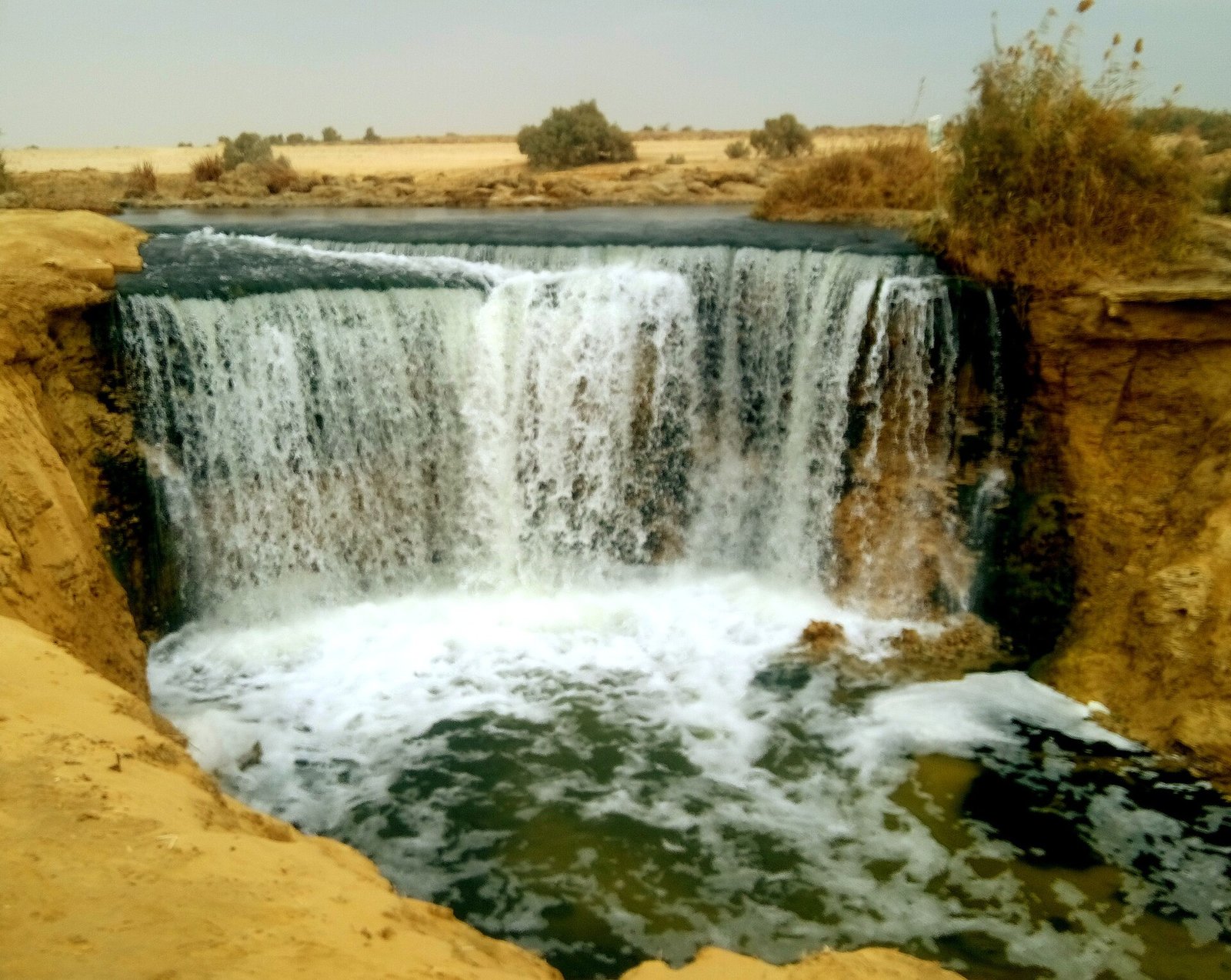
Wadi el Rayan: the only waterfalls in Egypt, and the Magic Lake
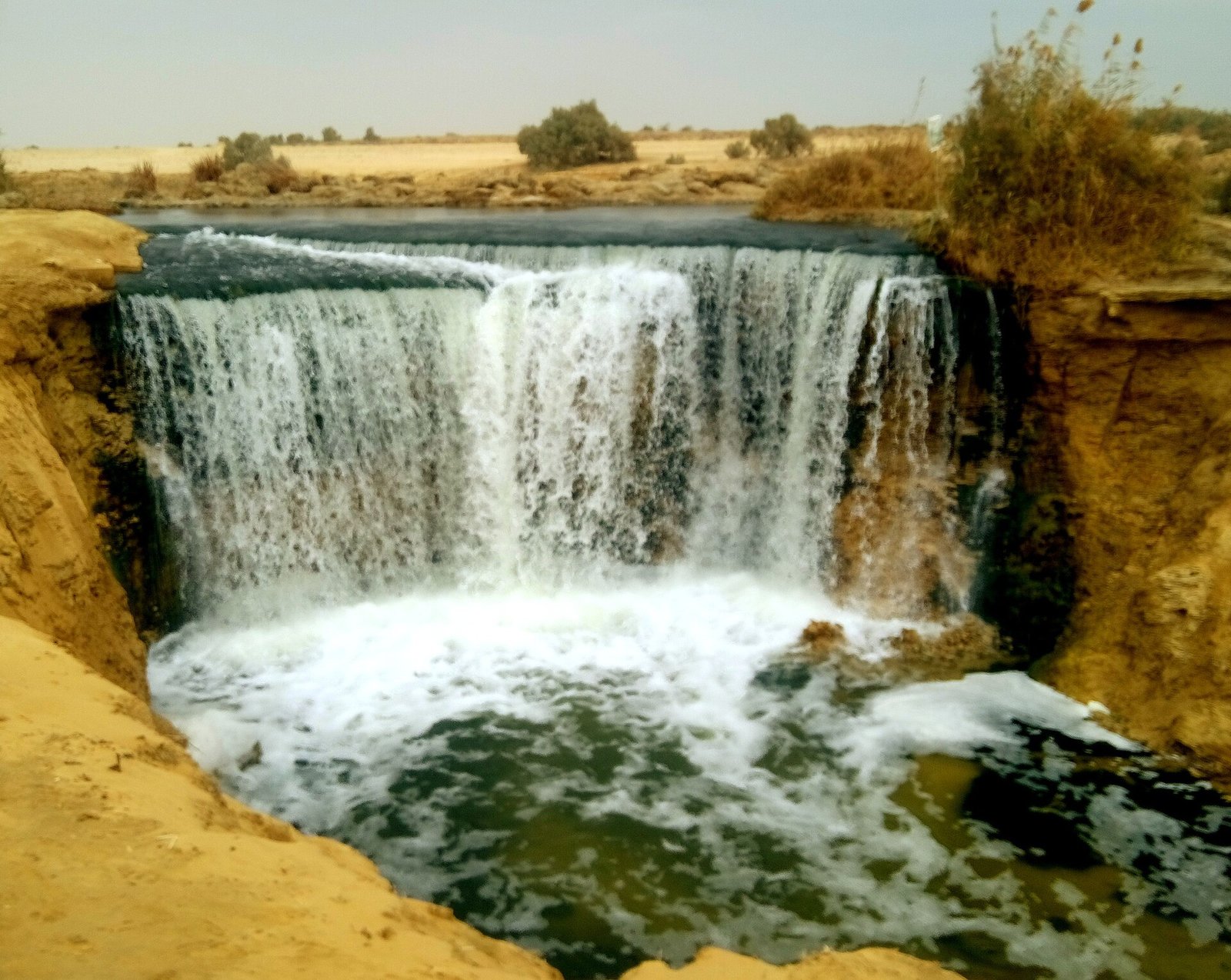
Southwest of Lake Qarun the road climbs out of the farmland into the Wadi el Rayan protected area. In the 1970s Egypt began pumping drainage water from the Fayoum fields into this valley. Two lakes formed, joined by a short channel where the water drops over a rock ledge.
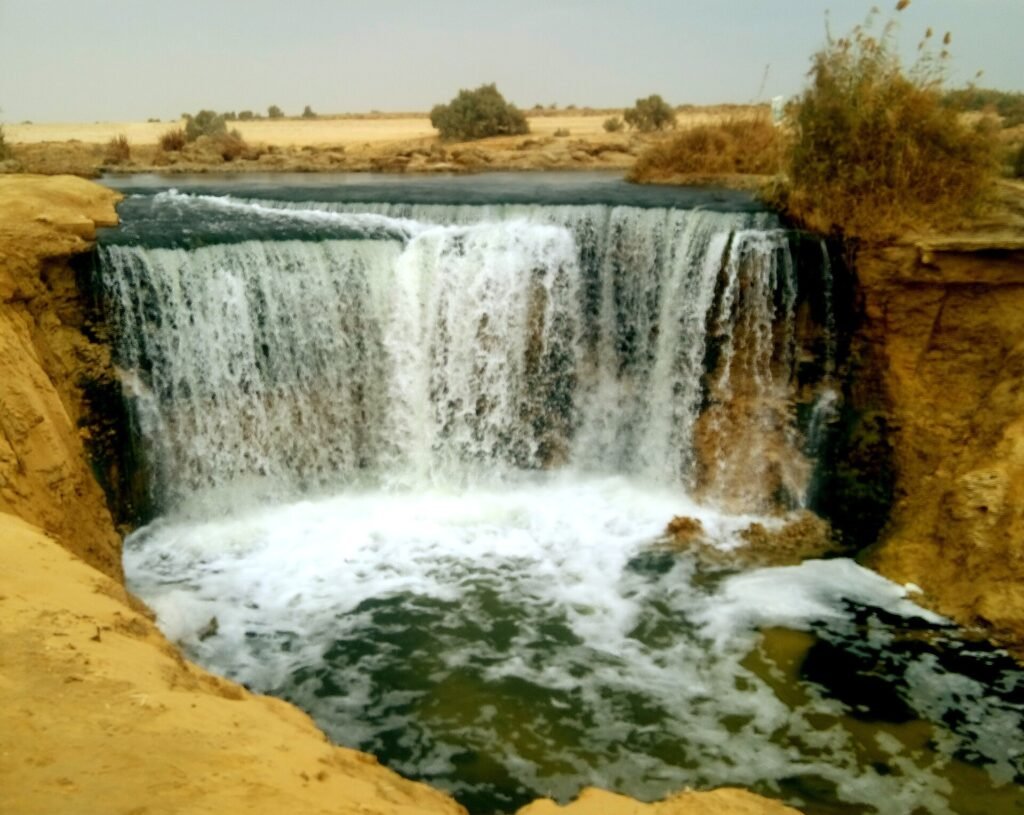
These are the waterfalls of Wadi el Rayan, and they are a few feet high. In a country with no other falling water, that is enough for a Friday picnic crowd from Cairo. The interest is the setting: blue water, reeds and dunes rolling down to the shore with nothing man made in sight.
A rough track continues to the Magic Lake, a small pool ringed by dunes that changes color as the light moves. This is where the sandboarding happens, on a long soft slope that ends near the water. Sunset here is the image most people keep from Fayoum.
Wadi el Hitan: whale skeletons in the Sahara
About 20 miles of desert track beyond Wadi el Rayan lies the reason Fayoum is on the UNESCO list. Wadi el Hitan, the Valley of the Whales, holds hundreds of fossil skeletons of early whales that died here around 40 million years ago, when this part of the Sahara was the floor of a warm sea.
The two main species are Basilosaurus, a serpent-like predator up to 60 feet long, and the smaller Dorudon. What makes them famous is their legs. Basilosaurus still had tiny hind limbs with knees and toes, useless for walking. It is the clearest evidence of whales evolving from land mammals back into the sea.
The site is a walking trail of roughly two miles, with skeletons left where they were found under simple shelters, between wind-carved rock towers. There is no shade, so start early, carry water and wear a hat.
Our full guide to visiting Wadi el Hitan and its whale fossils covers the trail and the museum. The short version: it is the most extraordinary thing in Fayoum, it needs a 4x4, and you cannot combine it with the archaeology in a single day.
Tunis village and the pottery
Tunis is a small village on a rise above the south shore of Lake Qarun, and for forty years it has been Fayoum's artist colony. A Swiss potter settled here in the 1980s and taught village children to throw and glaze. Those children now run their own studios, and the village has more than a dozen workshops, a few galleries and a scattering of mud-brick ecolodges looking down to the water.
The pottery has a recognizable style: glazed earthenware in blues, greens and ochres, painted with fish, birds, palms and the donkeys you just drove past. Shipping is not an option, so buy what fits in your suitcase and pack it in your clothes.
Tunis is also where you sleep if you stay overnight, and a walk between the workshops plus an hour on a terrace is a good use of the middle of the day. In the cooler months the village holds a pottery festival that fills every room for miles, so check the dates before you pick a night.
The Fayoum portraits, and where to actually see them
You will hear about the Fayoum portraits and you will not see many of them in Fayoum. Between the first and third centuries AD, under Roman rule, well-off families had a painted wooden panel of the deceased placed over the face of the mummy. Around a thousand survive, most dug up at Hawara in the late nineteenth century.
Painted in encaustic, pigment mixed with hot beeswax, they show individual people with tired eyes, Roman haircuts, gold earrings and direct gazes, and they are the oldest surviving painted portraits of real faces in the world.
The best group in Egypt hangs in the Egyptian Museum in Tahrir Square, so see them in Cairo before or after the trip. The small museum at Kom Aushim, near the entrance to Fayoum, has a modest collection beside the ruins of the Greco-Roman town of Karanis, a sensible first stop on the way in.
Hawara, the Labyrinth, Qasr Qarun and Medinet Madi
Fayoum has an archaeological circuit that almost nobody drives, because the whales and the lakes take the day. If you have a second day, these are the stops.
- Hawara. The mud-brick pyramid of Amenemhat III stands where the Bahr Yusef enters the basin. Next to it was his mortuary temple, which Herodotus described as a labyrinth of thousands of rooms that impressed him more than the pyramids. Almost nothing stands today; you walk a field of limestone chips over the most famous lost building of the ancient world.
- Qasr Qarun. A well-preserved Ptolemaic temple to Sobek at the far western end of the lake, a compact stone box with stairs to the roof and a view across the water. On the winter solstice the rising sun lights the sanctuary.
- Medinet Madi. The only Middle Kingdom temple in Egypt with substantial standing remains, built by Amenemhat III and IV for the cobra goddess Renenutet and for Sobek. It gets a handful of visitors a week.
- Meidum. Just outside Fayoum on the Nile side, the pyramid of Sneferu that lost its casing and now looks like a stone tower on a hill of rubble. It pairs with Hawara and El Lahun, or with Memphis and Saqqara on the way back to Cairo.
Tell us what you want to see and we build the route around it.
Birdwatching on the lake, and why winter is the time
Lake Qarun and the Wadi el Rayan lakes are among the best birdwatching spots in Egypt, and almost no foreign visitor knows it. The basin lies on a flyway between Europe and Africa, and from October to March the reed beds fill with wintering birds: flamingos along the salt flats, herons, spoonbills, cormorants and rafts of ducks and waders.
The best viewing is from a boat on the western reaches of Lake Qarun at first light, or from the shore of the lower Wadi el Rayan lake. Bring binoculars and patience. Our drivers know where the flamingos have been standing that week.
This is the strongest argument for the overnight. A day tripper reaches the lake at midday, when the birds are far out and the light is flat. A guest in Tunis is on the water at dawn.
The drive from Cairo, and what the traffic does to your day
Fayoum city is about 60 miles from downtown Cairo on a good divided highway, so the driving itself takes about an hour and a half. The variable is getting out of Cairo. From Giza at 7 am you are on the desert road in twenty minutes; from Zamalek or Heliopolis at 8:30 am you can spend an hour reaching the ring road.
So the rule is simple: early departure, west-side pickup if you can, breakfast box in the car. We aim to be at Kom Aushim or the lake by 9 am.
Paved roads reach the lake, Tunis, the waterfalls and the archaeological sites. The stretch from the lower Wadi el Rayan lake to Wadi el Hitan is graded desert track, and the Magic Lake and the dunes are sand, so we switch to a 4x4 there. There is no public transportation between the sights.
Day trip or overnight in Fayoum?
Fayoum has two halves and a day fits one of them. The green half is Lake Qarun, Tunis, Kom Aushim and one or two ancient sites. The desert half is Wadi el Rayan, the Magic Lake, sandboarding and Wadi el Hitan. Doing both in a day means two hours of desert track on top of four hours of highway.
| Format | What fits | Best for | What you miss |
|---|---|---|---|
| Day trip, desert half | Wadi el Rayan falls, Magic Lake, sandboarding, Wadi el Hitan, fish lunch by the lake | Families, first visit, anyone who came for the whales | Tunis pottery, the archaeology, sunset on Lake Qarun |
| Day trip, green half | Kom Aushim, Hawara, Tunis workshops, boat on Lake Qarun, Qasr Qarun | History and art travelers, photographers | The whales, the dunes, the waterfalls |
| One night in Tunis | Both halves without hurrying, sunset at the Magic Lake, dawn birds | Anyone with two days spare in Cairo, couples, birders | Nothing, except a night in a city hotel |
If you have the time, the overnight is the better trip by a wide margin. With one day, choose the desert half unless you are here for the portraits and the Labyrinth.
When to go: seasons in Fayoum, in Fahrenheit and Celsius
Fayoum runs a few degrees hotter than Cairo by day and colder by night.
| Season | Daytime highs | Nights | What it means for the trip |
|---|---|---|---|
| October to November | 77 to 88 F (25 to 31 C) | 55 to 65 F (13 to 18 C) | The best window. Warm days on the dunes, cool evenings in Tunis, the first migrating birds. |
| December to February | 64 to 70 F (18 to 21 C) | 41 to 50 F (5 to 10 C) | Ideal for the whale valley walk and peak birdwatching. Bring a real jacket for the dawn boat. |
| March to April | 75 to 88 F (24 to 31 C) | 54 to 63 F (12 to 17 C) | Fine, with one catch: the khamsin, a hot dusty south wind that can close the desert track for a day or two. |
| May to September | 95 to 105 F (35 to 41 C) | 70 to 79 F (21 to 26 C) | The whale valley is punishing after 10 am. In summer we run Fayoum only as an early start with the lake and Tunis in the afternoon. |
Our guide to the best time to visit Egypt covers the whole country month by month. For Fayoum, November and February are the two months we would pick.
Who Fayoum suits, and who should skip it
Fayoum is for the traveler who has already booked the Pyramids, the museum and the Nile cruise and wants one day that feels like nowhere else. It suits families, because kids flagging on their fourth temple wake up for a whale skeleton and a sand dune. It suits couples who want a quiet night with stars, birders, potters and anyone who likes empty landscapes.
It is a weak choice if you have three days in Egypt total, because those belong to Giza, Saqqara and Luxor. It is a poor fit for travelers with limited mobility who want the whales, since the fossil trail is soft sand and rock, although the lake, Tunis and Qasr Qarun are manageable.
For most of our guests it ranks with a night in the White Desert among the unique experiences in Egypt that people talk about afterward more than the famous sites.
How Explora Egipto runs a Fayoum trip
We are a local agency with our own vehicles and guides, and Fayoum is one of the Cairo excursions we run most often outside the classic circuit. Every trip is private: your group, one car, one guide.
- Pickup at your Cairo or Giza hotel between 6:30 and 7:30 am, in an air-conditioned car with a licensed driver.
- Guide in English, who handles the tickets at Wadi el Rayan, Wadi el Hitan and the archaeological sites.
- 4x4 switch at the park for the whale valley and the dunes, with sandboards in the back if you want them.
- Lunch of grilled fish by the lake or in a Tunis garden restaurant, with a stop at the workshops if the route allows.
- Return to your hotel around sunset, or check-in at a Tunis ecolodge for the overnight, with a boat on the lake the next morning.
The day also slots between your Cairo days and a domestic flight to Luxor or Aswan. Send us your dates and the version you want and we send you the quote.
Frequently asked questions
Is Fayoum worth visiting on a short trip to Egypt?
If you have four or more days in Cairo, yes, and it is often the day people remember most. If you have two or three, no: those belong to the Pyramids, Saqqara and the museums. It is a landscape day, best for travelers who want a change from monuments and for families with restless kids.
How far is Fayoum from Cairo and how long is the drive?
Fayoum city is about 60 miles southwest of central Cairo, roughly an hour and a half on the desert highway, but leaving the city late from the east side of the Nile can add an hour. Wadi el Hitan is a further hour and a half beyond Fayoum city.
Can you see Wadi el Hitan and Tunis village in one day?
You can touch both, but you cannot do both well. The whale valley takes the middle of the day with the drive in and out on the track, and Tunis is on the other side of the basin. If the pottery and the archaeology matter as much as the fossils, stay the night in Tunis.
Do I need a 4x4 in Fayoum?
Only for the desert half. Paved roads reach Lake Qarun, Tunis, the Wadi el Rayan waterfalls and every archaeological site. The Magic Lake, the sandboarding dunes and the final stretch to Wadi el Hitan are sand and graded track where a normal car will get stuck. We either run the whole day in a 4x4 or switch vehicles at the park gate.
Are the Wadi el Rayan waterfalls really waterfalls?
They are small, a few feet of water over a rock ledge between two man-made desert lakes, and still the only waterfalls in Egypt. Go for the setting rather than the drop: blue water, reeds and dunes sliding into the lake.
Where can I see the Fayoum mummy portraits?
Mostly not in Fayoum. The best group in Egypt is in the Egyptian Museum in Tahrir Square, and the small museum at Kom Aushim near the Fayoum entrance has a few. In Fayoum itself you visit Hawara, the cemetery where many were excavated.
See the Egypt that has no pyramids in it
Tell us your Cairo dates, whether you want the whales, the pottery village or both, and whether you can spare a night. We come back with a private route, our own car and guide, and the quote.